My thoughts: Why a Town Council for Guildford is a Positive Thing
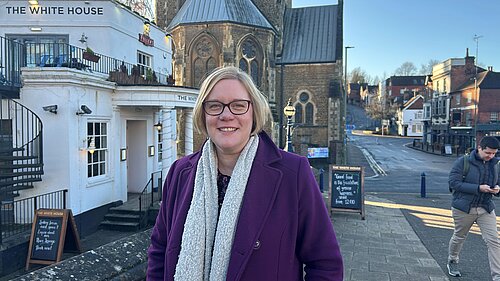
It will not surprise anyone to hear me say that I love Guildford town area – after all, I’m the MP for Guildford constituency. But it’s deeper than that. I grew up in Farnham and have loved Guildford since my pre-teens. I came here on school trips (Henley Fort, the Cathedral, walking tour of the town), the place for shopping with friends, cinema trips. I then moved here for university. I met my husband here, bought my first house in Bellfields, have raised my two sons here and so on. So, when I say I love Guildford, I really mean it.
There are big changes happening in the way Guildford Borough will be run going forward and this has significant implications for our town. It’s going to be part of a new council that goes from Haslemere in the south to Stanwell in the north and, with the best will in the world, that council’s focus is not going to be the detailed needs of our historic county town and the wider urban area. Especially when this new West Surrey Council faces an estimated £4.5 billion deficit from day one.
So I want to ensure that there’s a plan in place to make sure that the needs and future of Guildford are prioritised in this new era. I think the best and most obvious solution is a Guildford Town Council.
Why a Town Council?
Town/parish councils are a tried and tested way of giving an area a clear, local voice. Across Guildford constituency, we have nine excellent parish councils (23 in the Borough). Within those parishes, they have councillors for different areas (wards) and a clerk (some have other staff) who listen and act in the interests of their area across a range of issues.
I’ve seen what a great job that these parishes do, and I am convinced that we need one for the currently unparished area of Guildford town and the surrounding area. The alternative option of a local area committee works by the (West Surrey) Council appointing people to that panel, not local people having their say – I don’t think that’s right or fair.
Incidentally, I’m so convinced by the importance of town and parish councils that I recently penned this op ed in support of a report by Surrey Association of Local Councils – the collective voice of parish and town councils in Surrey – on the impact they make. You can read it here.
What Exactly Does a Town Council Do?
Towns and parish councils can decide the sorts of activities they would like to provide for their residents, and there are some key functions that almost all town councils perform. These include:
Public Spaces: Management of local parks, allotments, and floral displays.
Community Assets: Oversight of community centres and public toilets
Running the office of a Town Mayor
Small-Scale Infrastructure: Maintenance of bus shelters, benches, and litter bins.
Planning Voice: Acting as a "statutory consultee" to ensure the views of local residents are heard on developments before they are decided by the local planning authority, which would be the West Surrey Unitary.
Who Would Run It?
If we had a town council, it would be made up of councillors who are local residents, elected by their neighbours every four years to represent local views and to campaign on local concerns such as traffic, development or services. Councillors can stand for election as representatives of a political party or as independents.
The council also employs a clerk, who handles the administration of the council and ensures that legislation is complied with. They can also employ other people to specific roles depending on what is needed to deliver the services they provide.
Town councillors are volunteers, often unpaid, who give their time for the benefit of their community. If the council chooses to, they may receive a contribution to expenses or an allowance which allows them to carry out their work.
Why Do We Need One?
As I said at the start, there’s a real risk that the new West Surrey Unitary Council will not prioritise the small things that make daily life enjoyable here in Guildford, such as Christmas lights, heritage events, and the upkeep of our unique town-centre amenities. Not because they don’t want to, but because they don’t have the bandwidth to do so, as they will be focused on funding high-cost services like Adult and Children’s Services, Housing, Waste Management and Planning. They will also be dealing with the complexities of setting up the new Council and addressing the estimated £4.5 billion deficit.
When budgets are tight, these discretionary services are often the first to be cut. A Guildford Town Council would ring-fence these funds, ensuring Guildford stays vibrant rather than being treated as just another postcode in a vast administrative zone.
What Could It Cost?
I know that money is right for people right across our town, so it’s important to be upfront – there is a small cost to make this happen. But I believe that this is worth paying to ensure we have a local voice, run services locally and so on. (Remember, councillors aren’t paid so this wouldn’t be about creating paid councillor jobs.) For those who get council tax relief this would also be applicable to the precept – so if you don’t pay council tax now, you won’t pay a town council precept.
A Town Council is funded through a precept, which is a small addition to your Council Tax. This precept pays for the town clerk and the services that the council chooses to operate.
It is important to put this cost into perspective. Currently, in areas of Surrey that already have parish councils, this local charge typically represents about 1% to 2% of your total annual bill. While most of your tax (roughly 75%) goes to the County for major services like social care, the Town Council portion is the only part that is raised in Guildford and stays in Guildford.
Making the Most of Local Development
A Town Council could also unlock a vital revenue stream: Developer Funds.
When new houses are built, developers are required to pay a Community Infrastructure Levy (CIL) in some boroughs. Guildford Borough has not adopted CIL, but we are gathering the evidence necessary to start the process, as part of the Local Plan Update.
Where there is a Town council with a Neighbourhood Plan, 25% of that money is handed directly to the local community to spend on projects residents actually want.
Where there is no Town Council, that figure drops to 15%, and the money is held by the distant Unitary Council, where it could be spent elsewhere in West Surrey.
In Summary
A Guildford Town Council is an insurance policy for our community, our historic county town.
For about 1% of your tax bill, it keeps your money local, protects the soul of our town from budget cuts, and ensures we get the maximum possible funding from new developments. (Whether you’re in the town centre or the wards around it.)
A Town Council is the hyper-local tier of government.
While the massive West Surrey Unitary authority focuses on strategic issues like social care and major highways, a Town Council handles the things you see when you step out of your front door.
Have Your Say
Guildford Borough Council is currently consulting residents on how a Guildford Town Council could be set up. The deadline for submitting your response to the consultation is 1st March 2026.
You can make sure you have your say by:
Completing the questionnaire online: the quickest and most cost-effective way. Click here to go to the questionnaire.
Complete a printed questionnaire: If you live in the unparished urban area of Guildford, an information pack will have been sent to your household by Guildford Borough Council.
Once complete, please return this by post to Guildford Borough Council either:in person (Sat nav postcode GU2 4BE)
OR by post to the address below:
Community Governance Review
Millmead House
Millmead
Guildford
Surrey, GU2 4BBOR take a clear photo of your paper response and email it as an attachment to CGR@guildford.gov.uk.